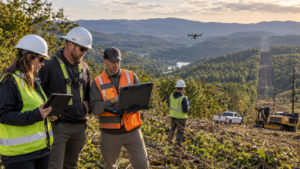
Large acreage vegetation management may appear to be an industry built primarily around heavy equipment, experienced operators, land knowledge, and field crews. Behind the scenes, however, modern vegetation management is becoming increasingly dependent on information technology. Companies responsible for maintaining hundreds or thousands of acres must coordinate people, equipment, properties, schedules, mapping data, customer information, safety documentation, and communications across large geographic areas. Reliable IT systems help bring all of those moving pieces together.
That connection is especially important in West Virginia. Mountainous terrain, rural properties, utility corridors, commercial land, industrial sites, transportation infrastructure, and expansive undeveloped acreage can create complicated operating conditions. West Virginia itself covers more than 24,000 square miles and contains terrain that often makes communication and field coordination more challenging than it would be in a compact urban environment, according to an overview of the state from Wikipedia.
For vegetation management companies working around Charleston and throughout the Mountain State, technology is no longer limited to an office computer and a company email account. IT now connects the office with the field, helps managers understand what is happening across distant properties, protects business information, and supports faster decisions.
GIS Technology Is Changing How Large Properties Are Managed
One of the clearest connections between vegetation management and information technology is Geographic Information Systems, commonly known as GIS. Large properties cannot always be managed efficiently using paper maps, written directions, or memory. Digital mapping provides another layer of information that can help companies organize work across large areas.
West Virginia already has substantial GIS infrastructure. The West Virginia GIS Technical Center provides statewide GIS services and supports West Virginia’s spatial data infrastructure, including mapping resources and the MapWV.gov platform.
For a vegetation management operation, mapping technology can help identify work zones, property boundaries, access points, roads, structures, slopes, waterways, utilities, and areas that require repeated attention. Crews can work from digital information rather than relying solely on printed instructions passed from an office to a field supervisor.
GIS can also make long-term vegetation planning more organized. A company responsible for maintaining a large commercial, industrial, institutional, or utility property can divide acreage into management zones and maintain records for each section. That allows the business to document completed work and develop a clearer schedule for future maintenance.
For property owners seeking Large Acreage Vegetation Management Charleston WV, the technology supporting the work can be nearly as important as the equipment entering the property. Effective management depends on knowing where crews need to go, what has already been completed, and what needs attention next.
Field Crews Need Reliable Digital Communication
Large acreage work frequently places employees far away from the main office. A supervisor may be on one property while equipment operators are working miles away and administrative staff are coordinating another project.
That makes communication technology an operational tool.
Mobile phones, tablets, cloud applications, digital work orders, GPS-enabled systems, and shared documents can allow information to move between employees without requiring everyone to return to a central office. A manager can update a work assignment, receive photographs from a job site, review progress, or send property information while crews remain in the field.
Reliable connectivity remains particularly relevant in West Virginia because many businesses operate across both developed and rural areas. The West Virginia Office of Broadband provides broadband availability information and mapping resources for communities throughout the state. West Virginia’s broadband program also reports ongoing work aimed at expanding high-speed internet service to additional locations.
For vegetation management businesses, improvements in broadband infrastructure can have consequences well beyond faster internet in the office. Connectivity supports cloud applications, mobile communications, remote access to company systems, electronic scheduling, online customer communication, and the movement of large files such as maps and property photographs.
GPS and Digital Mapping Improve Field Coordination
GPS technology has become deeply integrated into businesses that operate vehicles and equipment across large territories. Vegetation management companies can use location technology for more than simple driving directions.
Digital location information can help managers understand where vehicles are operating, organize routes between properties, locate crews, document service areas, and coordinate equipment movement. When projects involve hundreds of acres, knowing where work has occurred can help prevent unnecessary duplication and reduce confusion.
Digital maps can also provide a common reference point between the property owner, project manager, and field crew. Rather than describing an area as the section beyond a particular road or tree line, personnel can reference mapped locations and clearly defined management areas.
Geospatial technology has become an important part of modern land analysis. The U.S. Geological Survey maintains extensive mapping, geographic, land, and remote-sensing resources used throughout the United States. These types of geospatial technologies demonstrate how digital information can turn physical landscapes into data that can be viewed, analyzed, organized, and shared.
That principle translates directly to commercial land management. Better geographic information can support better operational decisions.
IT Helps Companies Track Fleets, Equipment and Maintenance
Large vegetation management companies often depend on expensive machinery. Depending on the project, fleets may include tractors, mowers, forestry equipment, trucks, trailers, skid steers, excavators, specialized cutting equipment, and other machines.
Managing those assets becomes easier when information is centralized.
Fleet management software can organize service schedules, operating hours, maintenance records, vehicle information, repair histories, and equipment assignments. Digital records can help managers recognize when machinery is approaching scheduled maintenance rather than discovering a problem after equipment fails at a remote property.
Equipment downtime has consequences that extend beyond the repair itself. A machine failure can affect employees, project schedules, transportation, subcontractors, and the property owner’s timeline. Technology gives managers greater visibility into the equipment supporting the operation.
This is another reason West Virginia IT has an increasingly important role in industries that historically would not have been categorized as technology businesses. Modern companies generate information every time an employee receives an assignment, a truck leaves the yard, equipment operates, a job is documented, or a customer receives an update.
IT provides the structure for keeping that information usable.
Cloud Systems Connect the Office With the Property
Cloud computing has changed the way field-service businesses operate. Information that once remained on a single office computer can now be made available to authorized employees from multiple locations.
A vegetation management company can maintain digital schedules, customer records, maps, work orders, photographs, proposals, invoices, safety information, and property documentation within connected systems.
That creates a continuous flow of information between administration and operations.
A customer may approve a project in the office while a project manager reviews the updated information from another location. A field supervisor can document completed work, and office personnel can access those records without waiting for paperwork to return.
For companies working throughout Kanawha County and surrounding areas, that ability to share information becomes increasingly valuable as the service territory expands.
Cloud technology also allows a company to preserve a history of a property. Previous work, photographs, notes, maps, and service records can become part of an ongoing digital file rather than being scattered among emails, paper folders, phones, and individual employee computers.
Cybersecurity Matters Outside Traditional Technology Companies
Greater reliance on technology creates another responsibility. Business information must be protected.
Vegetation management companies may maintain customer names, addresses, contracts, employee records, financial documents, property information, login credentials, payment information, photographs, maps, and internal communications. A cyber incident affecting those systems can interrupt operations even though the company’s primary business takes place outdoors.
The National Institute of Standards and Technology Cybersecurity Framework provides guidance designed to help organizations understand and manage cybersecurity risks. NIST emphasizes that its current Cybersecurity Framework is intended for organizations of different sizes and sectors, not solely large technology companies.
Basic IT planning therefore has practical value for a vegetation management business. Secure passwords, controlled user access, software updates, data backups, device management, network protection, and employee awareness can reduce unnecessary exposure.
Technology should help field operations move faster without creating vulnerabilities that threaten the business.
Broadband Access Has Become Business Infrastructure
Internet access was once viewed primarily as an office utility. Today it is part of the infrastructure supporting field operations.
The West Virginia Broadband Enhancement Council maintains resources that allow residents and businesses to examine broadband availability, including mapping tools and information concerning unserved areas.
Connectivity affects whether employees can transmit photographs, open cloud-based documents, access mapping platforms, update jobs, communicate with managers, or retrieve customer information from remote locations.
Companies operating in rural areas may therefore need technology plans that account for inconsistent connectivity. Systems should allow employees to work efficiently while recognizing that service conditions can vary significantly from one property to another.
Mobile hotspots, cellular connectivity, offline-capable applications, synchronized data, and properly configured devices can all become part of the operating strategy.
The nationwide Federal Communications Commission also plays a major role in broadband policy, communications infrastructure, and connectivity. For West Virginia businesses that depend increasingly on digital field operations, developments in communications infrastructure have direct economic relevance.
Data Creates Better Long-Term Vegetation Management
Information collected during individual projects can become valuable over time.
A company that records service dates, treated areas, photographs, equipment use, weather conditions, access information, and property notes begins developing a digital history of the land it manages.
That history can improve future planning.
Managers can compare previous work with current conditions, identify areas that require more frequent attention, review past equipment requirements, and prepare crews before they arrive. Large acreage management becomes more systematic because decisions can incorporate documented information rather than depending exclusively on memory.
The result is a transition from isolated projects to organized land-management programs.
This is where IT becomes particularly useful. Technology does not replace the experience of professionals who understand vegetation, terrain, machinery, and site conditions. It gives those professionals better ways to capture and use what they know.
IT Can Strengthen Customer Communication
Technology also changes what customers expect from service companies.
Property owners and facility managers increasingly conduct business digitally. They receive proposals electronically, communicate through email and mobile devices, review photographs, approve work remotely, and maintain digital records.
A vegetation management company with organized IT systems can provide more consistent communication throughout a project.
Digital photographs can document progress. Maps can clarify the scope of work. Electronic records can show when services were completed. Cloud-based information can help office employees answer customer requests without searching through stacks of paperwork.
For large properties, documentation can be especially useful because the customer may not physically inspect every acre after each phase of work.
Clear digital records can create transparency between the company performing the work and the organization responsible for the land.
Technology Supports Safety and Operational Organization
Large acreage vegetation work involves machinery, changing terrain, transportation, weather, and multiple employees working across expansive properties. Information technology can support the administrative side of safety by making important information easier to distribute and retain.
Companies can maintain digital safety procedures, equipment documentation, employee training records, incident reports, inspection forms, and property-specific instructions. Field personnel can have access to information without depending entirely on documents stored at headquarters.
Digital systems also provide management with a way to confirm that documentation has been received and maintained.
Technology itself does not create a safe work environment. Safety comes from training, responsible management, experienced employees, appropriate equipment, and established procedures. IT strengthens that system by making information easier to organize and communicate.
West Virginia IT Is Becoming Part of the Heavy-Equipment Economy
West Virginia’s technology economy does not exist separately from traditional industries. IT increasingly supports construction, energy, transportation, forestry, agriculture, manufacturing, land management, utilities, and other sectors built around physical work.
Large acreage vegetation management illustrates that relationship clearly.
A tractor may perform the cutting, but software can schedule the project. A crew may clear the property, but GPS can help define where the crew needs to work. A supervisor may understand the terrain from decades of experience, while GIS provides another layer of geographic information. Employees may operate equipment in the field, while cloud technology connects their work with the office.
Modern IT is most valuable when it disappears into the operation and simply helps people perform their jobs more effectively.
Conclusion
Large acreage vegetation management remains a hands-on industry. Properties still require experienced crews, capable machinery, careful planning, and an understanding of terrain and vegetation. Technology does not replace those fundamentals.
It strengthens them.
West Virginia IT can connect field crews with offices, organize geographic information, improve equipment tracking, support customer communication, protect company data, maintain project records, and give managers a clearer picture of operations spread across large territories.
As broadband connectivity, GIS platforms, mobile technology, cloud computing, GPS systems, and cybersecurity continue to develop, their influence will reach industries far beyond traditional technology companies.
For Charleston-area vegetation management businesses, the future of land management will increasingly combine equipment in the field with information moving behind the scenes. The companies capable of bringing those two worlds together will be better equipped to coordinate complicated projects, manage expanding service territories, document their work, and operate with greater efficiency throughout West Virginia.