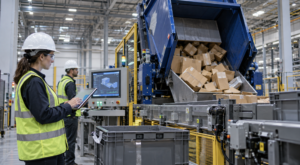
Modern warehouses are no longer defined only by shelving, forklifts, conveyors, and loading docks. Information technology has become a central part of warehouse operations, connecting equipment, inventory systems, employees, sensors, and management software into increasingly coordinated environments. That shift is also changing the role of industrial material-handling equipment.
Equipment that once performed a largely mechanical function can now operate as part of a much broader technology ecosystem. A Box Dumper is a good example. Its primary job remains straightforward: lift and empty containers, boxes, bins, or other bulk loads safely and efficiently. However, the surrounding technology is becoming more sophisticated as warehouses adopt connected controls, sensors, automated workflows, data collection, warehouse management software, and predictive maintenance systems.
This convergence between industrial machinery and IT reflects a larger transformation taking place across logistics and manufacturing. Wikipedia’s overview of information technology describes IT broadly as the use of computer and telecommunications systems to create, process, store, retrieve, and transmit information. Inside today’s warehouse, that information can now influence everything from inventory movement to equipment maintenance.
📦 The result is a warehouse where physical handling equipment and digital systems increasingly work together rather than operating as separate parts of the business.
IT Is Becoming Part of the Material-Handling Infrastructure
For decades, warehouse machinery was primarily evaluated according to mechanical factors such as lifting capacity, durability, cycle time, safety, and reliability. Those considerations remain essential, but companies are increasingly looking at another factor: how equipment fits into the digital infrastructure of the facility.
Modern warehouses frequently depend on warehouse management systems, enterprise resource planning platforms, barcode systems, RFID, programmable logic controllers, machine sensors, wireless networks, and cloud-based applications. When material-handling equipment becomes part of this environment, managers gain a clearer picture of what is occurring across the facility.
CIO has documented how Applied Materials modernized warehouse operations using technologies that include robots, RFID, automated workflows, sensors, software, and artificial intelligence. That kind of integration illustrates how deeply IT has entered an area that was once considered primarily mechanical.
A box dumper may represent only one stage of a material flow, but that stage can affect everything around it. Containers must arrive at the correct location. Materials may need to enter a conveyor, hopper, processing line, sorting system, or production operation. Downstream equipment must be ready to receive the load. Operators need to know whether the equipment is available and functioning properly.
IT creates the information layer that can help coordinate those activities.
Sensors Are Giving Warehouse Equipment a Digital Voice
One of the most significant changes in industrial technology has been the spread of sensors. Sensors allow equipment to generate information about operating conditions instead of remaining invisible to the digital systems around it.
Depending on the application and equipment configuration, industrial machinery can be monitored for information such as position, cycle activity, motor performance, temperature, vibration, operating time, and equipment status. This information can then be used locally by control systems or transmitted to other applications for analysis.
This concept is closely connected to the Industrial Internet of Things. Network World’s coverage of IoT in warehouse environments has highlighted how connected devices, sensors, wireless communications, machine learning, and edge computing can contribute to warehouse operations.
For facilities using box dumping equipment, better visibility can support more organized workflows. Management can potentially understand how frequently equipment is being used, when production peaks occur, where delays develop, and when maintenance may be necessary.
That transforms equipment data into operational information.
Instead of discovering a problem only after a machine becomes unavailable, warehouse personnel can increasingly use digital monitoring to identify abnormal conditions earlier. The mechanical equipment still performs the physical task, but IT makes the operation more visible.
Warehouse Automation Is Creating Connected Workflows
Automation is expanding rapidly throughout logistics. Robots move totes. Automated storage and retrieval systems transport products. Conveyors route packages. Vision systems identify objects. Software determines where inventory should travel.
TechCrunch’s reporting on warehouse automation has shown how major logistics companies are investing in robotics to handle repetitive and physically demanding warehouse work. This trend has important implications for traditional industrial equipment as well.
A warehouse does not become automated simply because a robot has been installed. Effective automation requires equipment, software, controls, sensors, employees, and processes to function together.
That is where IT plays an essential role.
A box dumper positioned within an automated material flow can become one link in a larger sequence. A container may arrive at the dumping station, material may be discharged, and downstream equipment may move it to the next processing area. Digital control systems can help coordinate timing so that equipment is available when needed and unnecessary interruptions are reduced.
⚙️ The value of automation increasingly comes from coordination rather than from isolated machines performing isolated jobs.
Warehouse Management Systems Are Connecting Information With Movement
Warehouse management systems have changed how companies view inventory. Instead of relying solely on manual counts and employee knowledge, modern facilities can track products and materials as they move through receiving, storage, picking, processing, packing, and shipping.
The next stage is connecting that information more closely with physical operations.
When software understands where materials are located and equipment systems understand when materials are arriving, companies can create more synchronized workflows. That synchronization can help prevent situations where one area becomes overloaded while another sits idle.
InformationWeek’s coverage of IT automation reflects a broader technology movement toward connecting data, workflows, automation, and intelligent systems.
In a material-handling environment, this means decisions can increasingly be based on live operating information rather than estimates.
For example, warehouse data may identify periods when large volumes of containers reach a particular processing area. Operations teams can use that information to adjust staffing, equipment availability, maintenance schedules, or production timing.
The goal is not technology for its own sake. The goal is to use information to make physical operations more predictable and efficient.
Artificial Intelligence Is Expanding the Capabilities of Warehouse Automation
Artificial intelligence receives enormous attention in the technology industry, but some of its most practical applications are happening far away from consumer chatbots. Warehouses, factories, logistics operations, and distribution centers are becoming important testing grounds for intelligent automation.
Ars Technica has reported on the development of increasingly autonomous workplace robots, including systems designed for warehouses and manufacturing environments. These technologies demonstrate how AI can help machines interpret their surroundings and perform physical tasks with greater autonomy.
The connection to conventional material-handling equipment is important.
Not every machine needs artificial intelligence. Many industrial tasks are repetitive and clearly defined, making dependable mechanical and control systems the better solution. However, AI can still influence the larger system surrounding those machines.
Software may analyze equipment utilization, identify unusual patterns, predict demand, optimize material routing, or determine when maintenance should be scheduled. Rather than replacing proven equipment, intelligent systems can help facilities determine how and when that equipment should be used.
This creates a practical relationship between traditional industrial engineering and modern IT.
Predictive Maintenance Can Reduce Unexpected Downtime
Maintenance has traditionally followed one of two models. Equipment is serviced according to a predetermined schedule, or repairs occur after a problem develops. Connected technology is creating another option.
Condition monitoring can provide data that helps maintenance teams identify changes in equipment performance. When those changes indicate developing problems, maintenance can potentially be scheduled before a failure interrupts production.
This is especially valuable in warehouses where individual pieces of equipment are part of interconnected workflows. A failure at one station can affect conveyors, employees, production schedules, shipping deadlines, and equipment located farther down the line.
Predictive maintenance therefore becomes more than a maintenance issue. It becomes an information-management issue.
Historical operating data can also help companies understand equipment life cycles. Maintenance teams can compare performance over time, recognize recurring issues, and make better decisions about repairs, replacement parts, and equipment upgrades.
The result is a shift from reactive maintenance toward data-supported maintenance planning.
Cybersecurity Is Now Part of Industrial Equipment Planning
Connecting industrial equipment to networks provides operational advantages, but connectivity also introduces responsibilities.
Warehouse IT departments must consider how connected equipment communicates, which systems can access it, how software updates are managed, and how operational networks are protected. Industrial cybersecurity is becoming increasingly important as operational technology and traditional IT infrastructure move closer together.
That does not mean every piece of warehouse equipment needs a direct internet connection. In many cases, companies deliberately separate operational technology from other systems or carefully control which information passes between networks.
The important change is that cybersecurity can no longer be considered solely an office-computer issue.
Connected sensors, controllers, warehouse management platforms, industrial computers, wireless networks, cloud applications, and automated machines all contribute to the technology environment.
As IT becomes more involved in material handling, cooperation between warehouse managers, maintenance teams, engineers, equipment suppliers, and cybersecurity professionals becomes increasingly valuable.
Human Workers Remain Central to the Smart Warehouse
The growth of warehouse automation sometimes creates the impression that fully autonomous facilities are about to eliminate human involvement. Real-world warehouse technology is more complicated.
WIRED’s reporting from automated warehouse environments has illustrated how humans and machines often perform different but complementary functions. Robots and automated equipment can excel at repetitive movement, while people remain essential for supervision, judgment, maintenance, exceptions, and tasks requiring flexibility.
The same principle applies to industrial dumping equipment.
Automating a physically demanding or repetitive handling task can allow employees to focus on responsibilities that require more judgment. IT can also provide operators with clearer equipment status information, helping them understand what is happening without relying entirely on visual inspection or manual communication.
Good warehouse technology does not simply add more machines. It improves how people interact with those machines.
👷 In that sense, the smart warehouse is not necessarily a warehouse without people. It is a warehouse where people have better tools, better information, and better control over physical processes.
Data Is Becoming a Warehouse Management Asset
Every equipment cycle can potentially produce useful operational information.
Over time, warehouse managers can analyze that information to understand equipment utilization, production volumes, recurring delays, downtime, maintenance history, and workflow patterns.
This information may reveal that certain equipment is heavily utilized during one shift but underused during another. It may show that material repeatedly arrives faster than downstream systems can process it. It may identify unnecessary waiting between stages of production.
Those observations can influence decisions about warehouse layout, staffing, equipment placement, maintenance, and future capital investment.
IT therefore changes the value of equipment in a subtle but important way. A machine is no longer valuable only because of the physical work it performs. The operational information surrounding that machine can also become valuable.
The Future Is an Integrated Warehouse
The most important warehouse technology trend is not any single robot, sensor, software platform, or piece of machinery. It is integration.
Mechanical systems will continue doing the heavy physical work that software cannot perform. IT systems will continue managing information. Sensors will connect the two. Warehouse management applications will provide coordination. Analytics will identify patterns. Employees will oversee operations and respond when conditions change.
As these systems become more closely integrated, equipment selection may increasingly involve both operations and IT teams.
Warehouse leaders will still evaluate capacity, durability, safety, construction quality, maintenance requirements, and operating costs. They may also consider connectivity, controls, available operating data, compatibility with automation systems, and how equipment can fit into future technology plans.
That represents a significant shift in industrial purchasing and warehouse design.
Conclusion
Information technology is moving deeper into the physical operation of warehouses, creating facilities where software and machinery increasingly operate as parts of the same system. Box dumper technology fits naturally into this transformation because material movement remains essential regardless of how sophisticated warehouse software becomes.
Sensors can provide operating visibility. Warehouse management systems can coordinate material flow. Analytics can reveal inefficiencies. Predictive maintenance can help reduce unexpected interruptions. Automation can connect multiple stages of material handling, while cybersecurity practices protect the increasingly connected infrastructure behind those operations.
The warehouse of the future will not be built entirely from software or entirely from machinery. It will depend on the interaction between both.
Industrial equipment will continue lifting, moving, positioning, emptying, conveying, and processing physical materials. IT will increasingly provide the intelligence needed to coordinate those actions across the facility.
That combination is turning the modern warehouse into something far more sophisticated than a storage building. It is becoming a connected operational environment in which information moves alongside inventory, equipment generates useful data, and digital systems help physical machinery work as part of a larger, more efficient process.