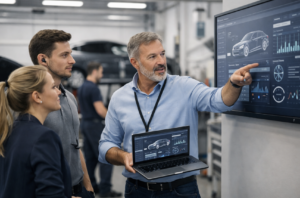
The modern service department is no longer driven by mechanical knowledge alone. It runs on communication systems, scheduling platforms, digital inspections, connected diagnostics, customer updates, reporting dashboards, cybersecurity controls, and cloud-based workflows. That shift has changed what strong leadership looks like in an automotive shop or dealership. A service manager still needs people skills, operational awareness, and technical understanding, but now that role also depends on how well technology is supported, organized, and used every day. Broader trends in IT service management and enterprise infrastructure show how strongly service quality now depends on disciplined systems, reliable delivery, and continual improvement.
That is why IT belongs in the conversation when businesses talk about manager development. The strongest training programs do more than teach a person how to dispatch work, handle technicians, or calm down an upset customer. They teach leaders how to function inside a digital environment where speed, visibility, and consistency matter. For companies investing in Automotive Service Manager training, IT support becomes a real advantage because it gives training a stronger foundation, better structure, and more staying power.
Technology Has Changed What Service Managers Need to Master
An automotive service manager now works in a highly connected environment. Repair orders move through software. Vehicle history is stored digitally. Inspections are documented with photos and notes. Customers expect text updates, approval links, and accurate timelines. Parts and labor data need to be visible in real time. Training someone for that role without strong IT support is like teaching leadership in only half the job. The systems are part of the work now, not an extra layer added afterward. As major technology platforms continue pushing AI, cloud coordination, and unified digital workflows into everyday operations, businesses in every sector are being forced to train leaders who can operate comfortably inside those systems.
When IT supports training well, the learning experience becomes more practical. Instead of vague theory, managers can be trained inside the actual tools they use. They can learn how to read dashboards, monitor workflow bottlenecks, manage digital approvals, review technician productivity, and keep communication moving without losing accuracy. That makes training more relevant and easier to retain because it mirrors the real environment of the service lane.
Better IT Support Makes Training More Consistent
One of the biggest problems in manager development is inconsistency. One location trains one way, another location trains a different way, and a third location relies almost entirely on verbal handoff. That creates uneven performance, uneven customer experience, and uneven accountability. IT helps solve that by giving companies a repeatable structure. Training materials can be centralized. Standard operating procedures can be stored and updated in one place. Role-based access can make sure the right people see the right information. Performance metrics can be tracked without relying on memory or guesswork. IBM has emphasized that enterprise clients are dealing with growing complexity across public cloud, private cloud, and on-premise environments, which makes automation and lifecycle management more valuable than ever.
Consistency matters because service managers shape the pace and culture of the department. When their training is supported by stable systems, they are more likely to make decisions based on current data rather than assumptions. They can see open tickets, pending approvals, delayed parts, technician load, appointment volume, and customer communication history in one connected view. That kind of visibility turns training into something measurable. Instead of hoping a manager is improving, the business can actually see improvement in response times, gross profit control, workflow movement, and customer follow-through.
Cybersecurity and Reliability Now Belong in the Training Conversation
Many businesses still think of IT support as something that only matters when a printer fails, a password is lost, or a workstation goes down. That view is outdated. In a modern service department, IT support also protects the systems that hold customer information, payment details, operational data, and internal communication. A manager who does not understand secure workflows can become a weak point even if they are excellent with people. The NIST Cybersecurity Framework 2.0 was built to help organizations of all sizes understand, assess, prioritize, and communicate cybersecurity risk, which shows how essential structured security thinking has become across industries.
This matters even more because the threat environment is not theoretical. The Microsoft Digital Defense Report 2025 reported that more than half of cyberattacks with known motivations were driven by extortion and ransomware, while phishing-resistant MFA can block more than 99% of identity-based attacks. At the same time, CISA Cybersecurity Advisories continue to publish guidance on recent and high-impact threats. For automotive service manager training, that means basic security habits should be treated as leadership habits. Managers need to know how to handle access permissions, protect customer records, recognize suspicious activity, follow proper approval chains, and work inside systems that are designed to reduce risk.
A well-trained manager should not have to become a cybersecurity engineer, but they do need to understand operational discipline. They need to know why shared logins are a problem, why approvals should be documented, why devices should be updated, and why customer data should never be handled casually. IT support helps reinforce those standards through better system design, better access control, and better training environments.
Cloud Tools and AI Are Raising the Standard
Automotive service departments are not isolated from broader technology trends. The same forces reshaping large organizations are also reshaping repair operations, dealership communication, and service reporting. At Google Cloud Next 25, Google highlighted AI agents, unified security, and high-speed network capabilities designed to help organizations work faster and more intelligently. Cisco made a similar point in Cisco Powers Secure Infrastructure for the AI Era, where it described AI-driven solutions meant to simplify IT operations, enhance automation, and strengthen proactive threat defense. Those developments point in one direction: digital operations are becoming more integrated, more automated, and more dependent on dependable IT support.
That has direct implications for manager training. Service managers need to be comfortable with systems that flag workflow problems, surface key alerts, assist with scheduling, support technician communication, and organize customer-facing updates. They do not need to become software developers, but they do need confidence in interpreting system outputs and acting on them wisely. When IT and training work together, managers learn how to use technology without becoming controlled by it. They become better at making judgment calls because the information around them is cleaner, faster, and more reliable.
Cloud security and platform integration also matter here. The launch of AWS Security Hub Extended reflects the market’s push toward unified visibility across endpoint, identity, network, data, cloud, AI, and security operations. That same mindset applies at the operational level in automotive service departments. The more connected the tools become, the more important it is that managers are trained inside an environment where systems talk to each other cleanly and support teams can resolve issues quickly.
Stronger IT Support Improves Accountability and Customer Experience
A service manager is responsible for much more than moving cars through the shop. That person is often the bridge between technician output, front-counter communication, parts timing, customer trust, and business profitability. When IT support is weak, that bridge becomes unstable. Appointments get buried. Notes go missing. Communication slows down. Customers hear different answers from different people. Technicians wait for approvals. Managers spend too much time chasing information instead of leading the department.
When IT support is strong, the opposite happens. Training becomes cleaner because expectations are visible. Escalations are easier to manage because records are available. Coaching becomes more specific because numbers and communication trails are accessible. A service manager can review trends, identify missed opportunities, and correct workflow problems early instead of reacting after the damage has already been done. That leads to a better experience for the customer because consistency behind the scenes almost always shows up at the front counter.
This is one reason businesses should stop seeing IT as a back-office expense and start seeing it as a training multiplier. Good systems do not replace leadership, but they do strengthen it. They reduce noise, reduce confusion, and reduce the number of avoidable mistakes that wear down both employees and customers. In a service department, that is not a small advantage. It affects trust, revenue, retention, and reputation.
The Best Training Programs Treat IT as Part of the Leadership Model
The future of automotive leadership belongs to managers who can lead people and work effectively inside a digital operating environment. They need to communicate clearly, protect data, understand workflow systems, use reporting wisely, and keep teams moving without creating chaos. None of that happens as well as it should when training and IT operate in separate worlds.
The strongest approach is to treat IT support as part of the training strategy from the beginning. That means building manager development around the real systems being used, protecting those systems properly, keeping documentation current, and giving leaders access to information they can actually use. It also means recognizing that the modern service department runs on both human judgment and technical infrastructure.
Conclusion
How IT supports better automotive service manager training comes down to one central idea: better systems produce better leaders when those systems are built into the training process. A manager who understands operations but struggles with digital tools will always be limited. A manager who is trained with the help of stable, secure, well-supported systems will be far more prepared to lead a department that depends on speed, clarity, accountability, and trust.
For IT websites, this topic matters because it shows how technology support reaches far beyond servers and software. It helps shape leadership quality inside real businesses. In the automotive world, that influence is now impossible to ignore. When IT support improves the way service managers are trained, it improves the way customers are served, teams are led, and operations are run.
Tags: Better IT Support Makes Training More ConsistentCloud Tools and AI Are Raising the StandardCybersecurity and Reliability Now Belong in the Training ConversationStronger IT Support Improves Accountability and Customer ExperienceTechnology Has Changed What Service Managers Need to MasterThe Best Training Programs Treat IT as Part of the Leadership Model